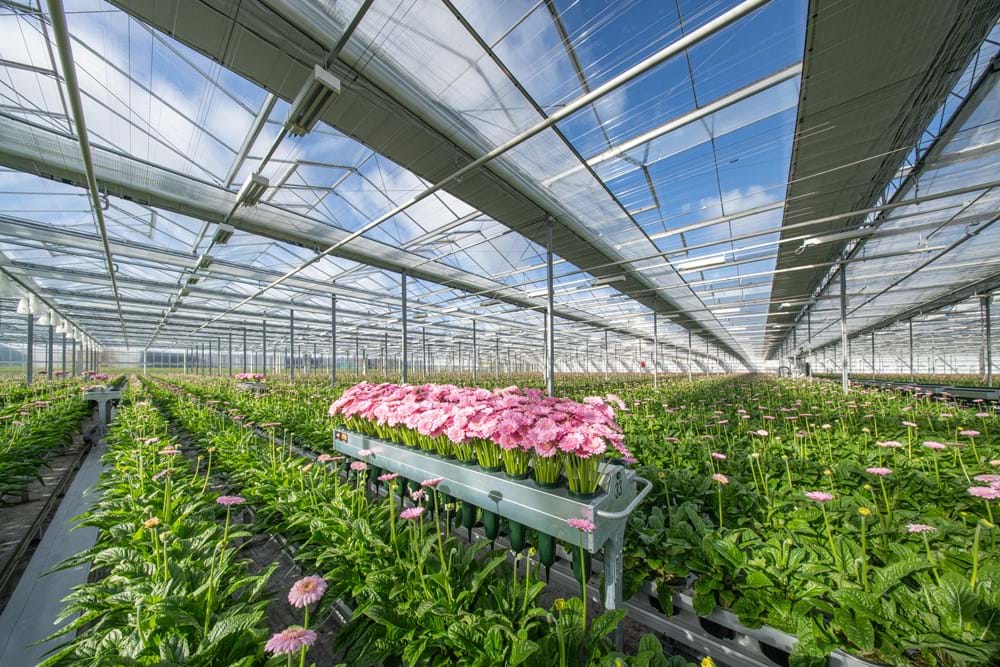
Gerbera nursery EveryD Flowers recently expanded from 12 to nearly 16 hectares. An existing rose greenhouse on Oostlaan in De Lier was completely converted into a gerbera greenhouse. Two Svensson climate screens were installed in the new greenhouse: an Obscura 10070 FR WB+BW blackout screen and the transparent energy screen Luxous Light FR. The installation was carried out by El Flaco Scherminstallaties, with whom EveryD Flowers has been collaborating for some time.
From roses to gerberas
The expansion came about when the opportunity arose to take over the rose location. “That was a strategic step for us,” says Hen Groenewegen, co-owner and cultivation specialist at EveryD Flowers. “We were at about 12 hectares, and with this location, we are expanding to nearly 16 hectares.” The former rose greenhouse of approximately four hectares was subsequently adapted for gerbera cultivation. “Much of the foundation was already good,” explains Hen. “The cultivation system and heating could remain. We adapted the system for pot trays and installed new screens.”
Two layers of screens
In the greenhouse, a combination of two layers of screens from Svensson was chosen: a blackout screen and a transparent energy screen. “We work with two layers of screens at several existing locations,” says Hen. “That is why the choice here was quite logical. We chose Obscura for blackout and Luxous Light as the energy screen.”
Additional reinforcement of the greenhouse
During the preparations, new pressure calculations revealed that the greenhouse structure required additional reinforcement for the second screen. Installer Peter van der Valk of El Flaco Scherminstallaties explains that such calculations are always the guiding principle. “The greenhouse seemed prepared for a second screen, but the calculations showed that the structure was just a little too light,” says Peter. “In that case, you have to reinforce the gutters and/or the gable end so that the load is properly absorbed.” Although that meant an extra step in the project, it ultimately provided certainty. “A few weeks later, there was snow,” says Hen. “At that point, I was actually quite glad that the greenhouse had been reinforced.”
Converted quickly
The conversion of the greenhouse was completed in a short time. Demolition and reconstruction of the greenhouse started in early October 2025. By early 2026, the first plants could already be moved back into the greenhouse. “In week four of the new year, the first gerberas were already in,” says Hen. Peter also looks back with satisfaction: “It was a big job, but we managed to complete it on schedule.”