How do we ensure that heat demand and plant temperature are maintained during the transition from SON-T to LED lighting? With this question, Vereijken Kwekerijen approached their regular supplier, Svensson. This resulted in the installation of the Luxous 1147 H2no FR climate screen. “If you deploy the screen smartly, you can save energy and dehumidify without incurring significant additional energy costs.”
Vereijken Kwekerijen cultivates approximately 60 hectares of tomatoes, 45 hectares of which are under artificial lighting and 15 hectares unlit. The company’s specialty is the Tasty Tom cocktail tomato—a brand that has existed for over 30 years and is one of the few brands to enjoy visible shelf presence in Albert Heijn supermarkets. The lit crops are grown under full-LED lighting, utilizing an average lighting capacity of 300 µmol. The company operates a total of seven locations: five in North Brabant, one in Limburg, and one in the Westland region.
The immediate impetus for investing in the H2no screen lay in the transition from SON-T to LED lighting, explains Ted Claessen, in-house cultivation advisor at Vereijken Kwekerijen. “We noticed that the heat requirement under full-LED lighting differs significantly from that under SON-T. In our lit crops, we experienced a higher demand for heat and found ourselves lacking sufficient plant temperature. Our conclusion was that a second screen was needed, to be installed alongside the existing Obscura blackout screen. The concept was to opt for an insulating screen, thereby allowing us to keep the screens closed for longer in the mornings—specifically during the period when we reopen the blackout screen to admit the bumblebees.”
Transparent water film
When selecting a second screen, the Luxous 1147 H2no FR climate screen emerged as a strong contender. This is a transparent energy screen featuring H2no technology, which causes water droplets to spread out into a continuous water film, explains Hugo Plaisier, an advisor at Svensson. “H2no is a technology added to the Luxous 1147 FR climate screen. This innovative screen prevents condensation from forming as tiny droplets; instead, condensation occurs in the form of a thin, transparent water film.”
The result is a significant increase—up to 8 percent—in light transmission during periods when condensation is present on the screen, he continues. “In winter, you are dealing with the boundary between the cold air above the screens and the warmer, more humid air below. Once crop transpiration and the temperature difference between the ridge and the growing area reach a certain threshold, condensation is bound to occur—particularly in crops grown under artificial lighting. H2no ensures that the light transmission properties of the dry fabric are maintained and remain unaffected by dew formation.”

Energy savings
“More light means higher production and greater energy savings, because screening can be maintained for longer periods,” explains Plaisier. “This screen is ideal for saving energy both during the day and at night. In principle, the H2no technology has been around for some time; we actually introduced the screen back in 2021. Over the past few years, however, interest in the screen has surged—driven by the focus on energy efficiency and the fact that an increasing number of growers are switching to full-LED lighting.” A key difference compared to existing anti-condensation solutions is the durability of the effect; the H2no property remains fully functional throughout the entire lifespan of the fabric, according to the advisor.
Added flexibility
At Vereijken Kwekerijen, a blackout screen was already in place for illuminated crops. For non-illuminated crops, operations often utilized an energy screen—and occasionally temporary film. “We identified a specific need regarding energy; we wanted to increase our insulation,” says Claessen. “That prompts you to look for a suitable screening system. A major advantage of a second screen lies not only in insulation but also in dehumidification. Traditionally, moisture was vented by creating a gap in the screen and raising the pipe temperature. This consumes energy and can lead to temperature disparities within the greenhouse.”
The current approach differs: we aim to keep the screen closed for as long as possible and vent the air above the screen, he continues. “Because screen fabrics are moisture-permeable, moisture can be transported upward through the screen, while the climate within the greenhouse—beneath the screen—remains uniform for as long as possible. Moreover, the use of two screens provides added flexibility. In non-illuminated crops, for instance, the upper screen can remain closed while the lower one is slightly vented—or vice versa. This allows for targeted dehumidification without disrupting the climate.”
“By utilizing a screen intelligently, you can simultaneously save energy and dehumidify without incurring significant additional energy costs. The H2no screen has enabled us to screen more extensively—or for longer periods—with minimal light loss.”
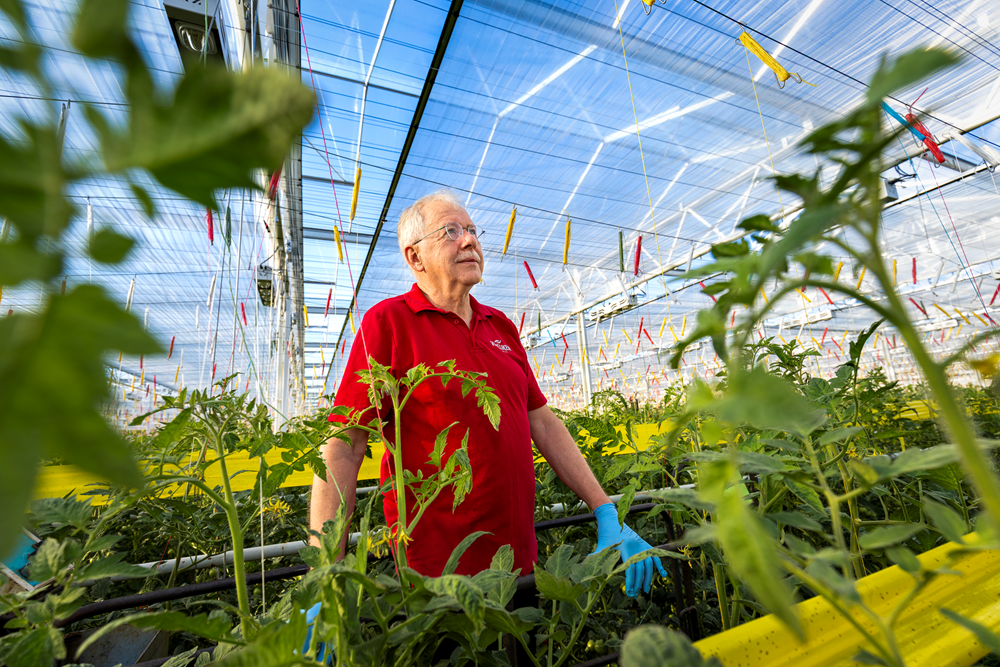
Screening for radiant heat loss
For a large part of the year, tomato nurseries operate based on the principle of screening against radiant heat loss. At the end of the day, the screen is closed—either partially or fully—to limit heat loss caused by radiation. This is particularly important in greenhouses equipped with full-LED lighting, as they lack the radiant heat typically provided by SON-T lighting systems. “In the past, we used a blackout screen for this purpose, but that meant blocking out the light quite early in the day. We now use the H2no screen because of its high light transmission.”
During the months of August, September, and October, however, radiant heat loss can actually help cool down a greenhouse that has become too warm—specifically during nights when the ambient temperature does not drop sufficiently. In such instances, plant temperatures can remain excessively high, and you actually *want* to take advantage of that radiant heat loss, notes Claessen. “Climate control remains a highly customized process; nothing runs on autopilot.”
The ‘Letterbox’ Principle
In the past, Vereijken also utilized summer screens. "That was a trend for a while," says Plaisier, "as it allowed growers to initiate cultivation under artificial lighting during the early summer. This is a delicate phase, as you are dealing with a mix of both mature and young plants. Summer screens feature an open structure and block approximately 15 percent of incoming light—just enough to ensure a smooth crop transition and shield the young plants from excessive radiation. However, due to rising gas prices, summer screens have since been replaced by energy screens. Yet, growers still need a way to screen out light to prevent young plants from growing too vigorously."
"Nowadays, we address this challenge by employing the ‘letterbox’ technique," Claessen adds. "We run an H2no screen and a blackout screen toward each other until the desired light level is achieved. Together, they cover 95 or 100 percent of the area. When you have both screens at your disposal, you can fine-tune this ratio: if you need to block out more light, for instance, you might set the ratio to 70-30 percent, gradually adjusting it over time to 30-70 percent. When using the letterbox method, however, it is crucial to prevent sunlight from streaming in through the screen gaps. To execute this correctly, the upper screen should be closed off toward the south or southwest, while the lower screen is closed off toward the north or northeast. This ensures that direct sunlight cannot penetrate the gaps between the screens."
Years of collaboration
Vereijken and Svensson have been working together for years, Claessen and Plaisier explain. Their collaboration intensified when Vereijken built its lit greenhouse in Beek en Donk in 2010. The decision to select the H2no screen also involved close consultation. Claessen: “We outlined our climate-related challenges and were looking for a transparent screen.” Plaisier: “We listen to the grower’s needs and set out to find the solution that works best for them. This depends heavily on their specific requirements.” Claessen: “The benefits lie not merely in energy savings percentages. They also stem from the ability to manage plant temperature, to dehumidify more extensively and for longer periods, and—crucially—from the assurance of being able to produce and supply Tasty Tom tomatoes that meet the agreed-upon quality standards.”