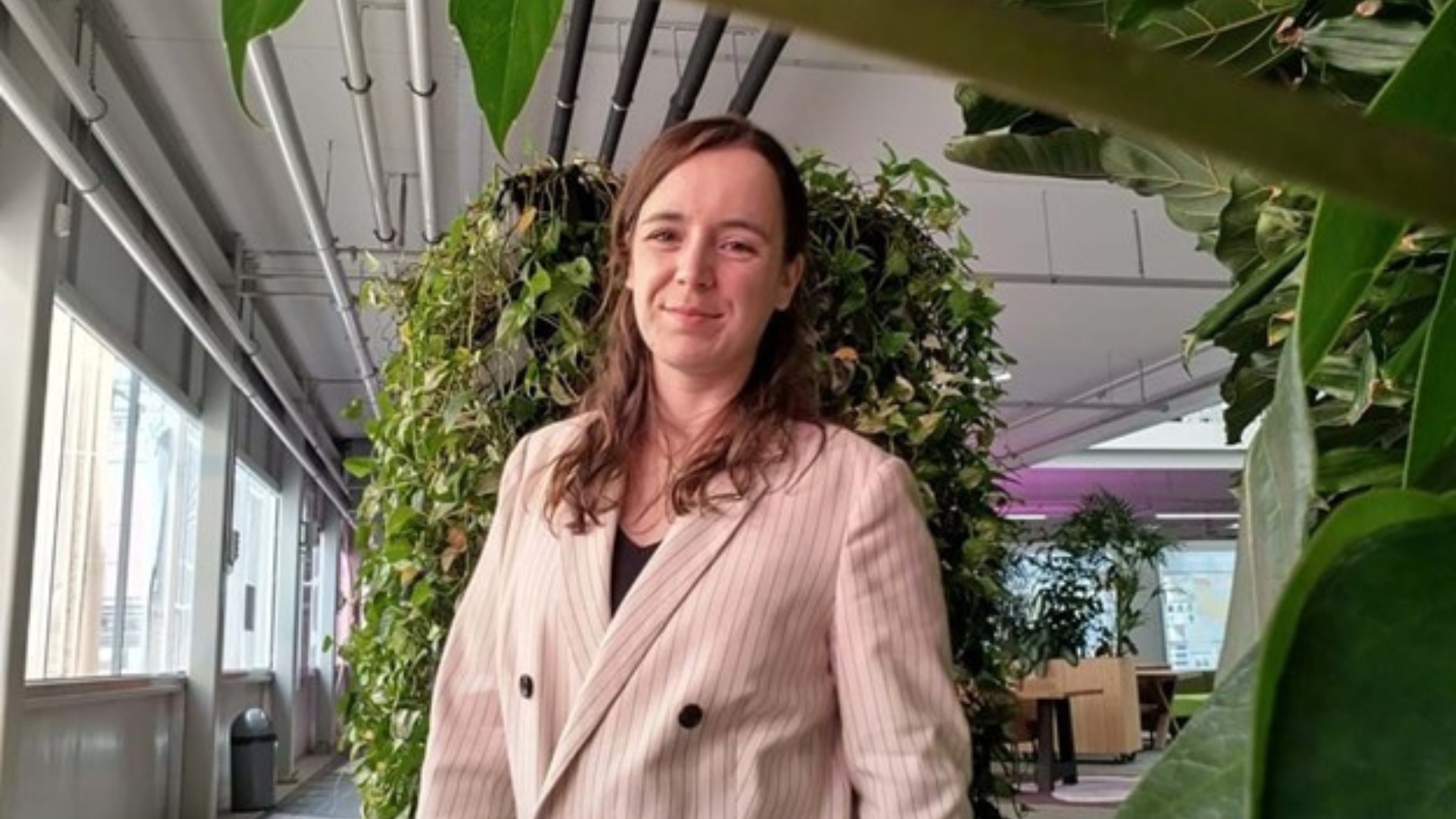
Gretchen Schimelpfenig is one of those people who seem to fit more into their working week than many of us find time for in a month. She works with greenhouse owners on energy projects and accessing rebates and grants, and runs Cornell University’s GLASE Consortium on greenhouse lighting and control, speaks at green industry conferences, and plays first fiddle in the Hildegard String Quartet. From a Vermont forest home, she manages to combine an engineer’s optimism, with a deep-felt mission to reduce the climate impact of horticulture and the built world.
You seem to approach life very purposefully? Where does that come from?
Gretchen: I have always wanted to help distill complicated information for everyone to understand. When I was eleven or twelve I saw a TV show called Design E2. It was about real-world green building projects all across the world, and I was like, THIS is where I can be of service.
I am trying to do everything I can to mitigate climate change on an industrial level. That's why I'm an engineer, to reduce the greenhouse gas emissions resulting from energy use in all types of buildings.
What’s the work-a-day stuff from which growers might know you?
Gretchen: So on a day to day basis, I'm usually focused on analyzing the energy savings of, say, a greenhouse curtain and understanding its energy savings from electricity and natural gas. Or I might be looking at something like an emerging technology that hasn't really been understood before and trying to quantify how can a business save energy using it and what the other benefits that they get from it beyond the energy savings. I do that for directly for businesses, but I also do that for utilities who create rebate programs. I work for a company called Energy Resources Integration (ERI), based in San Francisco. I’m based in Vermont, but ERI helps businesses all across North America.
How do you combine that with your role at the GLASE consortium?
Gretchen: Well, I work full time for ERI, applying my engineering expertise, I support Cornell academics in research and extension projects focused on greenhouses and impacts of technology on plants.
What’s on your desk at the moment?
Gretchen: One thing I’ve been doing with Svensson recently, as well as with other efficient technology manufacturers, is focusing on government programs from the United States Department of Agriculture (USDA).
We’ve been helping growers navigate the Rural Energy for America (REAP) program, which is a grant program for existing buildings and is a loan guarantee program for new construction. It can be used for greenhouse and indoor farms as well as more traditional agriculture.
Growers should know that there’s money on the table for some of the things they are building right now. Those who are applying for energy rebates from their utility should look to complement that with these USDA programs.
How has your focus been changing over time?
Gretchen: Well, coming from my mission a little more, I’ve had a focus on resilience in this last year or so. This isn’t so much about, look, here’s a program to reduce your emissions. Here my thought is that in the future it won’t be possible to rely on fossil fuels any longer. That’s a resilience issue. And then at the same time, here in Vermont we’ve had these extreme weather incidents like extreme freezes, floods, all sorts of things that have limited the availability of power and have had impacts on the supply chain.
These are things where you can make a decision to either be future-proofed in your operations, or to be reactive from incident to incident. So that’s my message currently. It’s not meant to be doom and gloom, but to be inspiring about taking control and making your operation resilient to what the future holds.
How about changes in the industry or policy focus?
Gretchen: I see that there’s a push to get growers to adopt emerging technologies. A lot of these new technologies, such as for decarbonizing the greenhouse, have yet to be characterized and quantified for their impact in all the different climate zones of the U.S. and Canada.
I’m involved in a long-term project to assess the greenhouse control systems for things like high performance lighting, greenhouse curtains, HVAC, all those sorts of things. Rebates and grants are available for these systems as long as you can quantify how much energy is being saved versus a baseline. Svensson’s Energy Monitor platform is very helpful for me as I find myself saying to the utility, hey, these greenhouse curtains are the technology that needs to be used in this project. They will then come back and say “okay, cool, where’s the data for me to validate it?” Thanks to Energy Monitor I can just say, oh, it’s right here. The data from Energy Monitor is ready to be exported to the grower, to the utility, or to whoever is going to pay for that energy saving.
That’s great to hear. So you utilize Svensson’s tools in your work?
Gretchen: Yes, one of the things I find exciting about working with Svensson is that we’ve historically worked with Svensson’s Energy Calculator. It tells me how much gas or other types of fossil fuels can be saved by using an energy curtain. Recently, I’ve been flipping that on its head with Svensson Climate Consultant, Paul Arena, and we’ve been looking at the cooling savings of different curtain strategies.
The California Utilities can then understand how much cooling would be saved by this triple shade curtain versus this more simple arrangement. And cooling is more expensive that heating in many cases. We’re currently working on a study where we’re using shade curtains and we’ll be able to see how much energy can be saved in kilowatt hours for the cooling systems of a greenhouse by employing a triple screen arrangement.
You’re scheduled to speak on a panel with Svensson at an ACT event again soon. What message will you be sharing with the growers in the audience?
Gretchen: I think it’s sharing about the state of the industry, some of the trends, some of the insights I’ve gained from my work at a national level. I’d like to show some of my recommendations for how to improve profitability and resiliency in their operations by employing energy efficient equipment and by working with me to get some money for doing that.
What sort of impact can the grant and rebate programs you work on offer growers in various regions?
Gretchen: It depends whether you are retrofitting or building from scratch. On the retrofit side, you’re almost always going to have the possibility to get an energy rebate. A utility typically will have something for horticulture, or they’ll have something more general and then they’ll try to fit you in that box. On the USDA side, there are grants for replacement projects. If you’re replacing old curtain that’s got a fault, or it’s gapping or torn, or you are upgrading to a higher level of insulation or a better shade level, then there is a potential energy saving. It varies from utility to utility. Some offer energy modelling help, or it may just be a form, but you may need help from someone like me.
When it comes to new construction, often there are investors involved in a large multi-million dollar project, and then you can for example get a loan guarantee for up to $25 million of energy efficient equipment. That’s for things like lighting, curtains, HVAC, etc. It's not a grant, so it’s not like money in your pocket. But it can reduce your finance costs with your investors because they know that at least part of their investment is going to be repaid no matter what happens.
Are there big variations state by state?
Gretchen: At utility level, yes, it’s a bit of a gamble. Some will cover up to $150,000 of energy costs while others have a cap of $1,000,000. Some cover 100% of projects costs, others up to 70%. These are just examples – programs vary by region and provider. It's also important to remember that when utilities and the government are trying to incentivize a change or shift, that incentive is not going to be there once the backers consider that the initiative has been successful. So, when you see one of these programs, it may be worth acting quickly because they go away. We saw that in California, that there was a great rebate program, but now that it’s been successful the utilities are ramping it down.
If you’re not in an area with a utility rebate program, don’t forget the USDA program where you can get up to 50% of project costs for retrofit, or 75% for new construction. Again, it’s capped at $25 million. In some places, if you stack together rebates and grants you could get 100% of your efficiency project costs covered.
And, first violin in a string quartet as well?
Gretchen: Ha ha, yes, there’s a lot to cover. I have a lot of talents and hobbies!