Uniform climate
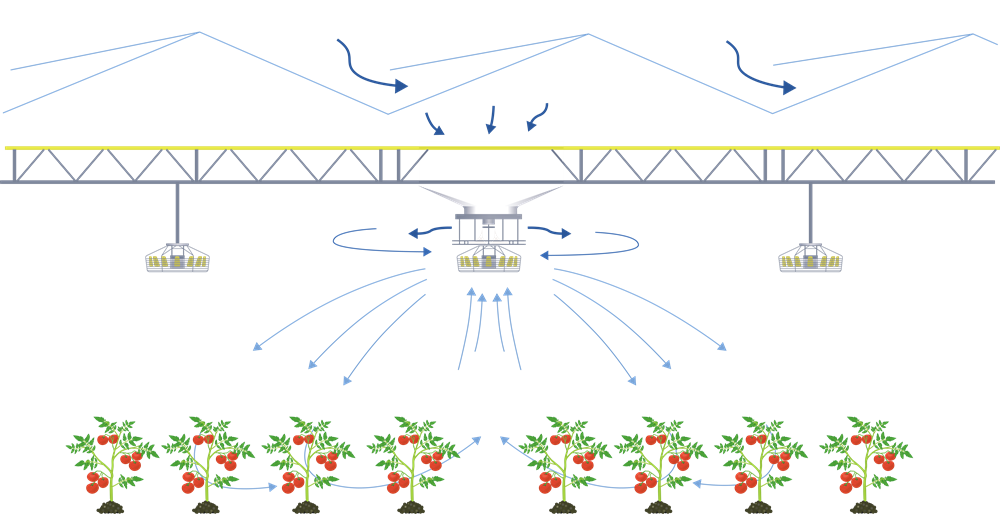
Fresh air circulates from above the screen into the crop, reducing moisture and improving uniformity.

Creating the perfect greenhouse climate is a challenge. Achieving uniform temperature and ideal humidity without gapping is complex, especially as growers face pressure to meet light pollution regulations and follow Plant Empowerment principles where gapping is not always possible.
That’s why we developed ClimaFlow, a climate solution that pairs vertical airflow technology with expert advisory support to improve energy efficiency and promote healthier plant growth.
Fresh air circulates from above the screen into the crop, reducing moisture and improving uniformity.

Improved airflow allows screens to stay closed longer, helping retain heat and reduce energy use.

Growers can use lights without gapping, complying with regulations while maintaining stable conditions.

We use climate data to optimize setup, performance, and long-term results for each greenhouse.
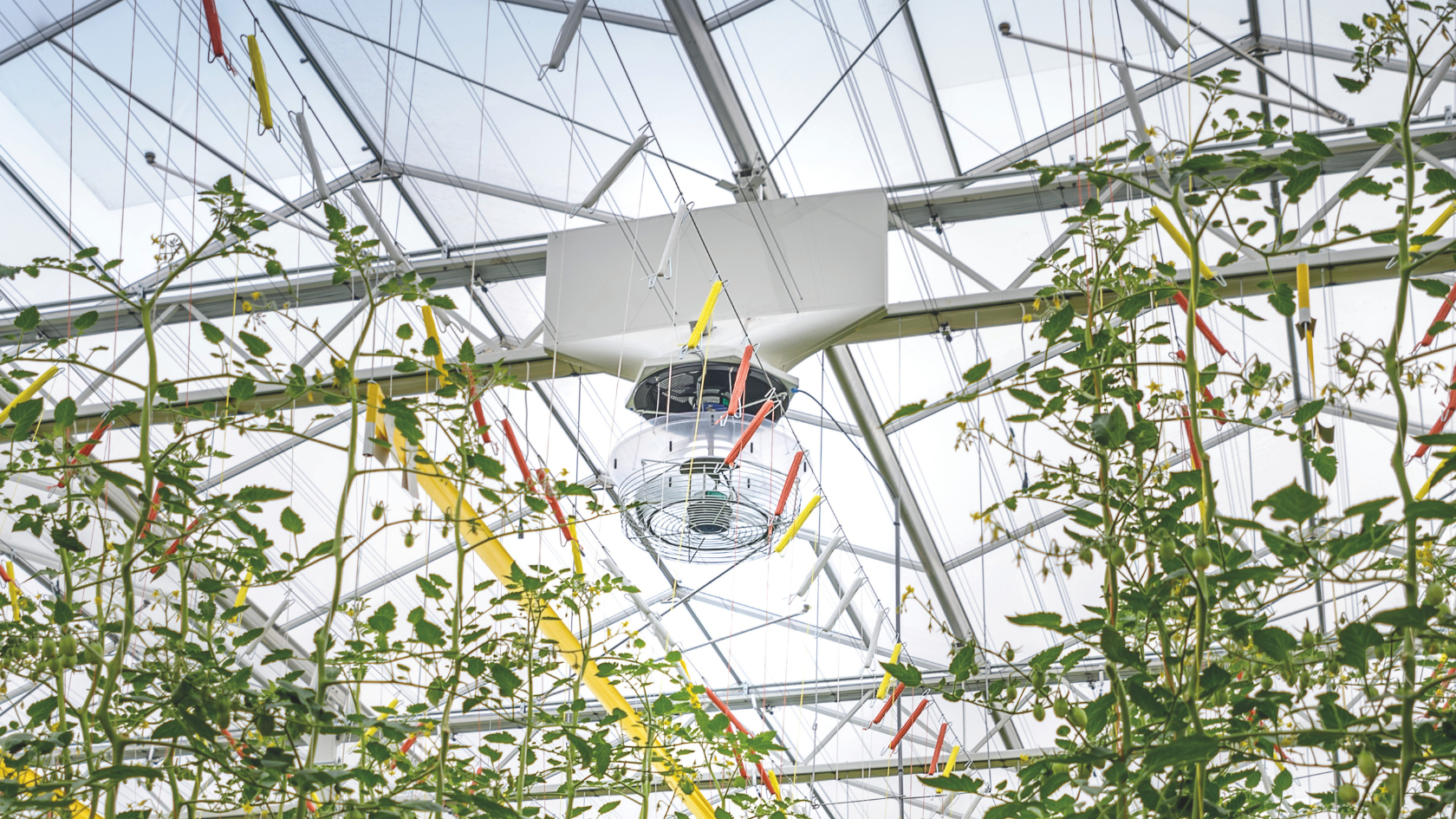
The ClimaFlow Systems consists of a VentilationJet and a vertical fan, the ClimaFlow Fan.
The VentilationJet draws fresh air from above the screen, distributing and mixing it with the greenhouse air throughout the growing area. The ClimaFlow Fan distributes the air evenly with a smooth and uniform flow throughout the crop canopy. This technique removes the evaporative moisture from within the crop, optimizing photosynthesis and creating an active, homogenous, and healthy microclimate.
With ClimaFlow, growers have the option of utilizing the full VentilationJet and vertical fan system, or just vertical fans.
Consistency from top to bottom.
ClimaFlow is more than a ventilation system. It comes with dedicated advisory services designed to help you get the most out of your investment. While you focus on running your business, our climate experts work alongside you to better understand your greenhouse conditions, analyze your climate data, and fine-tune how ClimaFlow and your screening strategy are used in practice.
Through data-driven analysis, regular consultations, and remote or on-site support, we help you improve climate consistency, plant health, and energy efficiency. Advice is tailored to your crops, your greenhouse, and your local conditions, with recommendations grounded in real climate computer data and Plant Empowerment principles where applicable.

Let’s talk about how ClimaFlow helps balance climate, reduce energy use, and create healthier growing conditions across your greenhouse.
Vertical fans move air down through the canopy, mixing the air more evenly from top to bottom. This helps avoid cold or humid pockets that often form when air only moves sideways. The result is a more uniform temperature and humidity — conditions your plants will notice right away.
It breaks up layers of still air, moves humidity away from leaf surfaces, and evens out temperature differences between the top and bottom of the greenhouse. That means fewer condensation problems and steadier transpiration, even on calm days.
Yes, but the ClimaFlow system is designed to replace most or all of your horizontal circulation. In practice, too much horizontal flow can interfere with the downward air pattern, so it’s best to plan your airflow as one integrated system.
In a fan-only setup, the vertical fans recirculate air inside the greenhouse. In a VentilationJet system, fresh air is drawn from above the energy screens and pushed down into the crop zone. Both improve air movement, but the VentilationJet adds dehumidification and air exchange.
When your main goal is to keep the air moving and conditions are already well controlled, the fan-only system is often sufficient. It’s a simple, energy-efficient way to prevent humidity build-up and temperature layering.
When you need more than circulation — for example, if screens must stay closed for light abatement, or if you want to pull in drier air from above the screens to reduce humidity. The VentilationJet is also ideal when external air is cooler or less humid and can improve your internal climate balance.
Yes. That’s one of its main advantages. It draws air from above the closed screens, mixes it with the air below, and distributes it downward. This keeps air fresh and humidity under control even when screens stay fully closed at night.
Both are driven by standard 0–10 V control signals, so fan speeds can be adjusted automatically to match climate needs — gentle mixing when conditions are stable, stronger circulation when humidity rises. This is a critical application for nurseries, for example, where it is desirable to be able to adjust airflow through young plants.
Roughly 250 m² per fan is a good design reference. The exact number depends on greenhouse height, crop density, and desired mixing intensity.
Yes, almost any. The system can be fitted in both new and existing houses. There’s also a compact VentilationJet Slim model that fits tighter trellis or ceiling spaces.
They should hang vertically — within about five degrees of straight — to avoid vibration and ensure the airflow pattern stays uniform. Each fan should also have enough free space above and below for the air column to form properly.
A more even temperature profile, lower average humidity, less condensation, and fewer local disease pressures. Most growers also report more predictable screen behaviour and energy savings because climate control becomes smoother and more stable.
Not necessarily, but it reduces the need for them. By moving and mixing air efficiently, it prevents moisture build-up before it becomes a problem — saving both energy and equipment runtime.