Having a dynamic screen that can be controlled instead of conventional painting is a big step forward. That extra quality means that these screens' profitability leverages every last square centimeter of arable land.
Growing ornamental Aloe under Harmony screens in Almería
-
- Greenhouse:
- Plantas del Cabo
-
- Location:
- Almería, Spain
-
- Crop:
- Aloe vera
-
- Challenge:
- Intense radiation, high temperatures
-
- Solution:
- Harmony 4015 O
NOVEMBER 2022
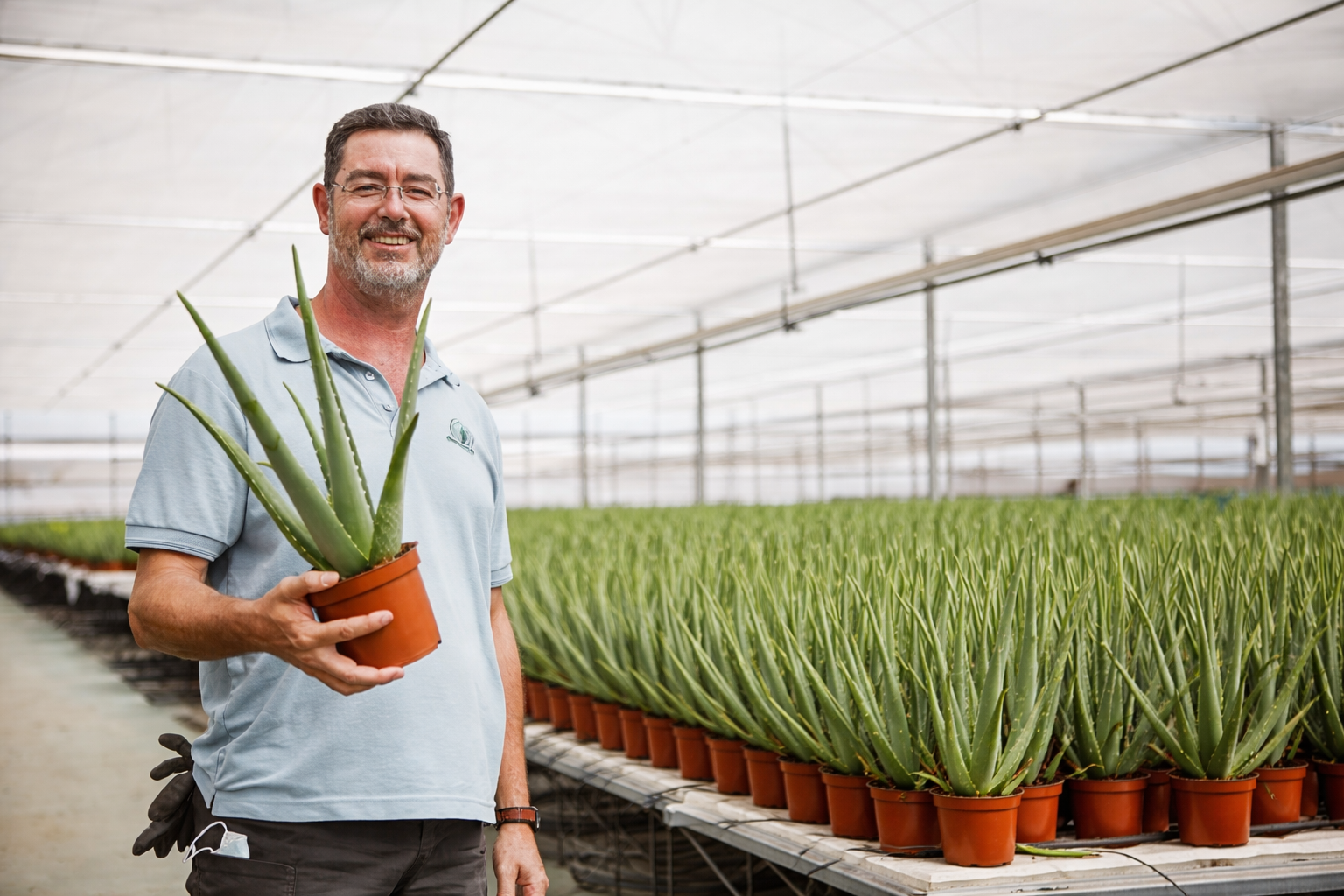
In a greenhouse located in the southern Spanish province of Almería in the sea of plastic”, we meet with José Manuel Sánchez Marín, the pioneer behind the company Plantas del Cabo.
On the way to Níjar, early in a September that has held on to summer's heat, we arrived at our appointment with José Manuel. He is an agricultural expert, farmer, and the driving force of Plantas del Cabo.
Svensson: Can you tell us about your background and how you started growing ornamental aloe vera?
“I started out growing tropical plants. My mother later discovered aloe vera because of its benefits for skin and health. She began experimenting to learn how to produce aloe gel, and step by step we learned how to grow plants that people really want to take home. What started small gradually grew as we gained more experience.”
Svensson: What makes growing in the Almería region both an opportunity and a challenge?
José Manuel: “Here in Almería we have a semi-arid climate with a lot of sunshine. You can almost see the greenhouse as a solar collector — the sun is like an infinite battery. At the same time, you have to manage excess heat in summer and lower temperatures in winter. Our goal is to produce quality plants while using as little fossil energy as possible. That gives us a competitive advantage compared to growers in northern Europe.”
Svensson: When did you first encounter Harmony climate screens?
José Manuel: “I first learned about Harmony screens at a trade fair in Germany in 2015, through Svensson’s distributor. What immediately interested me was that it was a dynamic, motor-controlled screen. Until then, we were using static blanching systems, which don’t offer the same level of control.”
Svensson: What made you decide to install a Harmony screen in your greenhouse?
José Manuel: “When I bought a greenhouse in Cabo de Gata, it still had old-fashioned screening technology. I decided to replace it right away with a Harmony-4015-O screen. I wanted better control of light and temperature, especially given our climate.”
Svensson: How does the Harmony-4015-O screen perform in practice?
José Manuel: “The screen diffuses the light very evenly and helps cool the greenhouse in summer. Because it is white, it reflects a lot of sunlight outward, which reduces the temperature inside while still letting enough radiation reach the plants. It’s about finding the right balance — the right number of micromoles or watts per square meter for the crop.”
Svensson: How does this compare to other screens you have used?
José Manuel: “I clearly see an improvement in plant quality and light distribution compared to screens from other suppliers. The Harmony screen gives us much more control over the growing conditions and helps us make better use of every square meter of the greenhouse.”
Svensson: How did recent challenges, such as extreme weather and the pandemic, affect your operation?
José Manuel: “During the coronavirus period, we experienced severe flooding at our previous site and lost part of our investment. It was a difficult moment, but it also gave us the opportunity to upgrade our greenhouse technology and restart production when the market opened up again.”
Svensson: How do you see the future for your business?
José Manuel: “We are cautiously optimistic. Almost 80 percent of our production is for export. Ornamental aloe vera is something we can grow here with very little energy, thanks to the climate and the right screening system. That’s something growers in other parts of Europe simply can’t do.”
Curious what made it all work?